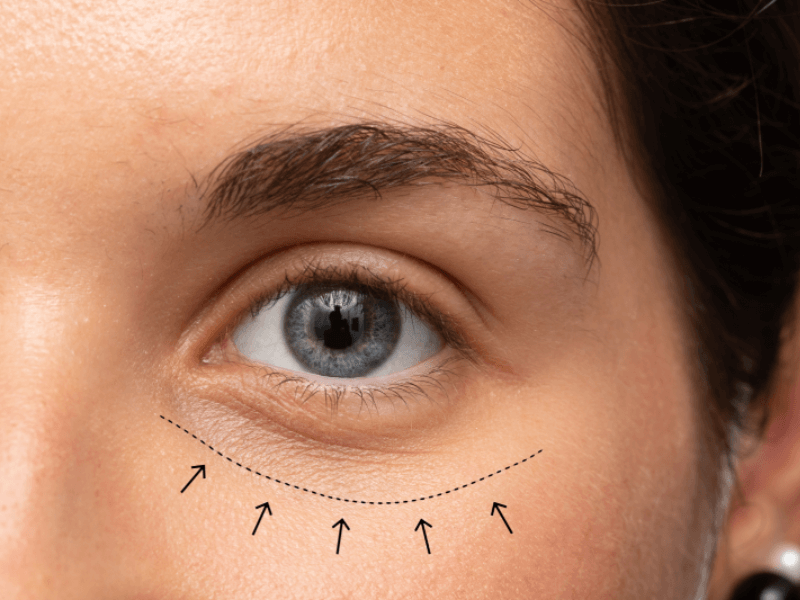
“Lower-eyelid rejuvenation is not a single procedure. A heavy, puffy, hollow, or wrinkled lower eyelid may involve the skin, orbicularis oculi muscle, orbital fat, tear trough, eyelid–cheek junction, lower-eyelid support, pigmentation, or several of these components together.
Before recommending treatment, the doctor should assess the amount and quality of skin, orbital-fat prominence, tear-trough anatomy, lower-eyelid position and tone, horizontal laxity, canthal support, eyelid vector, eye closure, ocular-surface health, and pre-existing asymmetry.
Lower blepharoplasty should not automatically involve removing both skin and fat. When excess skin is present, the amount removed must be conservative because excessive excision may contribute to lower-eyelid tightness, scleral show, retraction, or ectropion.
Prominent orbital fat may be reduced, preserved, or repositioned depending on the individual anatomy. Removing too much fat can create or worsen lower-eyelid hollowing and an abrupt transition between the eyelid and cheek.
Transconjunctival and transcutaneous approaches are not interchangeable. A transconjunctival approach provides access to orbital fat through the inner surface of the eyelid and does not directly remove external skin. A transcutaneous approach provides access through an external lower-eyelid incision and may be considered when treatment of excess skin is also required. The choice depends on the skin, fat, eyelid support, and the structures that require treatment.
A tear trough is not always caused by lower-eyelid descent. Natural anatomy, retaining structures, orbital-fat position, skeletal support, and soft-tissue volume may all contribute. Fat repositioning, autologous fat grafting, and hyaluronic acid filler therefore have different indications and limitations.
Lower-eyelid surgery cannot guarantee a wrinkle-free appearance, perfect symmetry, an invisible scar, or a permanently unchanged result. Possible concerns include dry-eye symptoms, chemosis, prolonged swelling, contour irregularity, lower-eyelid retraction, scleral show, ectropion, entropion, incomplete eye closure, and the need for additional treatment.
The goal is to treat the responsible structures conservatively while preserving lower-eyelid position, normal blinking, tear-film stability, comfortable eye closure, and a natural transition between the eyelid and cheek.”
Dr. Nguyen Thi Ly Na, Senior Specialist












 Schedule an Appointment


