


Subbrow Lift Combined with Lower Eyelid Surgery: When Is It Necessary?

Consulting doctor:
Over 10 years of experience in oculoplastic and facial plastic surgery.
See more information about the doctorThe aging of the lower eyelid is not always solely due to under-eye bags or excess skin; it can also be related to changes in the soft tissue of the cheeks and the supporting structure of the midface. Therefore, before deciding to combine a lifting procedure with lower eyelid surgery, the doctor needs to conduct a comprehensive assessment of the causes of aging while considering the preservation of tissue volume and eyelid function. The goal is to appropriately address the condition, aiming for a natural result that harmonizes with each client's facial features.
Dr. Nguyen Thi Ly Na, Senior Specialist
Brow Lift Combined with Lower Eyelid Surgery: When Is It Necessary to Rejuvenate Both the Eye and Cheek Areas?
Under-eye bags are prominent, tear troughs are becoming deeper, cheekbones appear less full, and the cheek area is sagging—these are common signs of aging in middle-aged women. These changes not only make the gaze appear heavy and lack vitality but also affect the harmony of the entire midface.
In some cases, performing only lower eyelid surgery may not fully address the signs of aging due to simultaneous changes in the structure of the eye and cheek areas. At this point, a brow lift combined with lower eyelid surgery is one of the solutions that doctors may consider to rejuvenate the midface more harmoniously.
So when should these two methods be combined? Who are the suitable candidates, and what should be noted before proceeding? Let’s explore this with Dr. Eye in the article below.
1. What Is Brow Lift Combined with Lower Eyelid Surgery?
Brow lift combined with lower eyelid surgery is a rejuvenation approach that involves improving under-eye bags, excess skin in the lower eyelid area, and supporting the soft tissues that have sagged in the upper cheek area, aiming for a smooth, natural transition between the lower eyelid and cheekbone.
The two methods have different intervention goals but can complement each other in cases of combined aging.
1.1. What Is a Brow Lift?
A brow lift is a commonly used term in aesthetics to describe the method of supporting and repositioning the soft tissues of the upper cheek area that have sagged, belonging to the group of midface rejuvenation solutions.
In terms of the solutionThe cheek area is formed by the combination of the cheekbone structure, fat compartments, muscles, supporting ligaments, and skin.
Over time, changes in these structures can cause the upper cheek area to lose fullness, the contour of the cheekbone to change, and the transition area between the eyes and cheeks to become more pronounced.
In suitable cases, cheek lifting aims to achieve the following goals:
- Support the soft tissue of the sagging cheek area.
- Enhance the contour of the upper cheek area.
- Smooth the transition area between the lower eyelid and the cheekbone.
- Help improve the nasolabial fold in some cases.
- Create harmony in the midface area.
It is important to note that cheek lifting is not simply about tightening the skin or lifting a specific muscle group. Depending on the chosen technique, the doctor may affect different soft tissue structures and supporting systems.
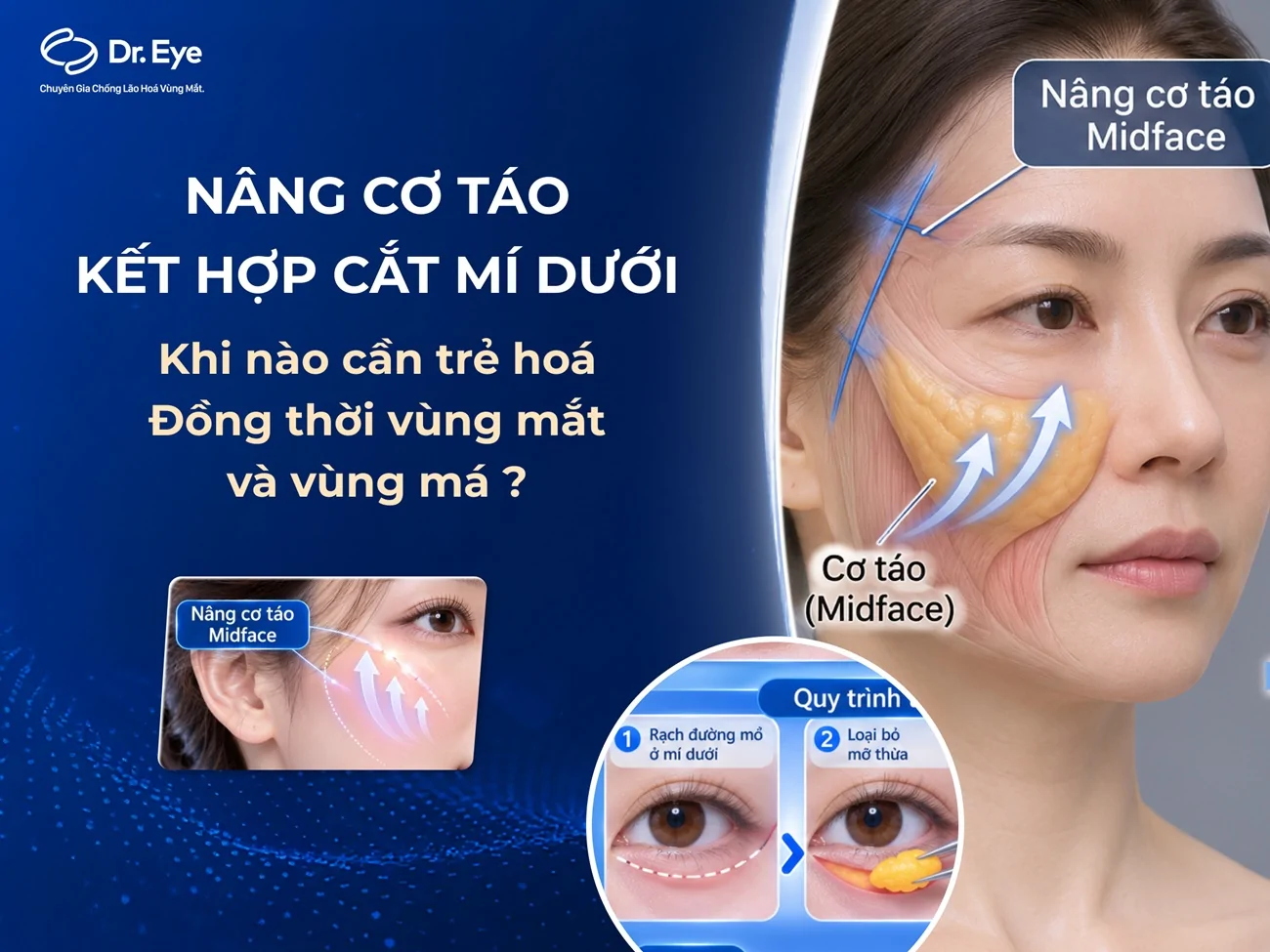
1.2. What is Lower Blepharoplasty?
Lower blepharoplasty is a cosmetic surgical procedure aimed at improving issues related to excess skin, under-eye bags, and the structure of the lower eyelid area.
Depending on the anatomical characteristics of each client, the doctor may consider addressing excess skin, adjusting the amount of fat, or redistributing fat appropriately to enhance the contour of the under-eye area.
This method aims to:
- Improve the condition of under-eye bags.underneath becomes more pronounced.
- Address excess skin appropriately.
- Support softening the tear trough in indicated cases.
- Help reduce the heaviness in the under-eye area, creating a more refined appearance.
However, lower eyelid surgery alone is not a specialized method for lifting sagging cheek tissue. This is why the doctor needs to assess both the eye area and the midface before making recommendations.
2. Why Does Aging Around the Eyes Often Accompany Cheek Aging?
The lower eyelid and upper cheek are two areas that are closely related anatomically. Aging in one area can affect the contours and appearance of the other.
2.1. Under-eye Fat Bags Become More Pronounced
As we age, the supportive structures in the lower eyelid area may weaken, causing the orbital fat to protrude forward and form under-eye bags.
When combined with reduced skin elasticity, the lower eyelid area may become saggy, develop more wrinkles, and create a heavy appearance.
2.2. Soft Tissue in the Cheek Tends to Sag
Changes in the fat compartments and supportive system of the midface can cause the soft tissue in the cheek to shift downward.
As a result, the fullness of the upper cheek decreases, and the transition area between the lower eyelid and cheek may become longer and more pronounced. This is one of the factors that can lead to a loss of the face’s natural freshness.
2.3. Tear Troughs Become Deeper and More Defined
The tear trough is a concave area that appears from the inner corner of the eye, extending diagonally downward and outward.
The formation of the tear trough may be related to variousFactors such as ligament characteristics, bone structure, fat tissue volume, the presence of under-eye bags, and sagging of the cheek area.
When the upper area has prominent fat bags and the lower area has a lack of volume or sagging tissue, the contrast between the two regions can make the tear trough more pronounced.
2.4. Decreased Skin Elasticity
The decline of collagen and elastin over time causes the skin around the eyes and cheeks to lose firmness.
However, aging occurs not only on the skin’s surface but also involves deeper structures. Therefore, simply addressing excess skin may not be sufficient for cases of multi-layered aging.
To develop an appropriate rejuvenation solution, the doctor needs to conduct a comprehensive assessment of the lower eyelid, tear trough, cheekbone, and the soft tissue system in the midface.
3. When Should You Consider a Combined Brow Lift and Lower Eyelid Surgery?
A combined brow lift and lower eyelid surgery is often considered when clients exhibit signs of aging in the lower eyelid area along with sagging soft tissue in the cheeks, rather than just having under-eye bags or excess skin alone.
3.1. Prominent Under-Eye Bags with Deep Tear Troughs and Sagging Cheeks
This is one of the conditions that requires a coordinated assessment of the eye and cheek areas.
When the lower eyelid fat bags are prominent, the tear trough is deep, and the upper cheek tissue has shifted downward, simply addressing the fat bags may not fully enhance the contours of the under-eye area.
The doctor may consider combining lower eyelid fat adjustment with cheek tissue support to improve the transition between the two areas.
3.2. Lower Eyelid with Excess Skin and Loss of Cheek Volume
In some womenMiddle-aged individuals often experience sagging lower eyelid skin alongside changes in the volume and position of the soft tissue in the cheek area.
If the primary cause of the lack of fullness in the cheek area is sagging soft tissue, a subbrow lift may be considered along with lower eyelid surgery.
Conversely, if the main issue is a volume deficiency, the doctor may need to consider volume augmentation methods instead of just lifting the tissue.
3.3. The Transition Between the Lower Eyelid and Cheek Becomes Pronounced
When young, the transition between the lower eyelid and upper cheek is usually relatively soft.
Over time, the simultaneous appearance of under-eye bags, tear troughs, and sagging cheek tissue can create distinct separation lines, making the mid-face area lack seamlessness.
In this case, combined rejuvenation may help improve the overall appearance of the under-eye and cheek area rather than focusing on a single flaw.
3.4. Pronounced Nasolabial Folds Accompanied by Signs of Lower Eyelid Aging
Deep nasolabial folds may be related to sagging cheek tissue, volume deficiency, or natural anatomical features.
If this condition occurs alongside under-eye bags and excess lower eyelid skin, the doctor may evaluate the possibility of combined rejuvenation.
However, a subbrow lift does not mean that it can completely eliminate nasolabial folds. The degree of improvement depends on the underlying causes and the facial structure of each client.
3.5. Desire for Harmonious Mid-Face Rejuvenation
Many middle-aged women not only wish to improve under-eye bags but also want their faces to appear fresher and more refined.but still maintain unique features.
When multiple signs of aging appear simultaneously, the doctor may consider developing a combined treatment plan to achieve harmonious results between the eye area and cheeks.
4. Distinguishing Cases That Require Lower Eyelid Surgery, Brow Lift, or a Combination of Both
Not all clients with under-eye bags or deep tear troughs need to undergo a brow lift combined with lower eyelid surgery.
The table below helps you better understand the intervention options that the doctor may consider based on each condition.
| Aging Condition | Reasons for Evaluation | Methods to Consider |
|---|---|---|
| Prominent lower eyelid fat, cheeks still full | Fat in the eye socket protruding forward | Lower eyelid surgery or appropriate fat management |
| Excess skin on the lower eyelid, cheeks not significantly sagging | Reduced skin elasticity | Lower eyelid surgery |
| Deep tear trough, cheeks lacking volume | Soft tissue deficiency, bone or ligament characteristics | Fat redistribution or volume enhancement when appropriate |
| Cheek tissue sagging, minimal excess skin and under-eye bags | Changes in the position of mid-face soft tissue | Brow lift or appropriate mid-face lifting method |
| Under-eye bags, excess skin, and sagging cheek tissue | Aging affecting multiple structures | Brow lift combined with lower eyelid surgery |
| Bags in the cheek area, swelling in the cheeks | Swelling, bags in the cheek area, or festoons | Specialized evaluation before choosing a method |
| Lower eyelidloose skin, sagging cheeks | Decreased support system for the lower eyelid and cheek tissue | Combined treatment plan, may require reinforcement of the lower eyelid structure |
The information in the table is for reference only and does not replace direct treatment recommendations from a doctor.
Are you unsure whether you only need lower eyelid surgery or should also consider a brow lift? Please leave your phone number so the Dr. Eye team can contact you for consultation support and schedule an appointment with a specialist.
5. What Benefits Does Combining a Brow Lift with Lower Eyelid Surgery Offer?
In suitable cases, combining the two methods can provide the following benefits:
5.1. Simultaneously Improve Multiple Signs of Aging
Instead of focusing solely on under-eye bags and excess skin on the lower eyelid, the combined approach also aims to improve the condition of the soft tissue in the sagging cheek area.
This helps address multiple factors affecting the appearance of the mid-face within a single rejuvenation plan.
5.2. Soften the Transition Between the Lower Eyelid and Cheekbone
Adjusting the structure of the lower eyelid while appropriately supporting the cheek tissue can help reduce the contrast between under-eye bags, tear troughs, and the upper cheek area.
As a result, the contours of the under-eye area can become softer and more seamless.
5.3. Minimize the Appearance of Deep Hollow Under-Eyes Due to Excess Fat RemovalLevel
In modern lower eyelid aesthetics, the goal is not simply to remove as much fat as possible.
Preserving and distributing tissue volume appropriately is crucial for the natural appearance of the eye area, especially in middle-aged women who have experienced volume loss in the midface.
Simultaneously assessing the cheek area helps the doctor consider the amount of tissue that needs to be preserved, adjusted, or supported appropriately.
5.4. Aiming for a Fresh, Natural Look
When changes in the lower eyelid and cheek area are harmoniously improved, the face can appear more refined, with a softer and fresher gaze.
At Dr. Eye, we aim for rejuvenation results that align with the age, anatomical features, and unique contours of each client, rather than creating excessive changes.
6. What Factors Does the Doctor Evaluate Before Recommending a Combined Brow Lift and Lower Eyelid Surgery?
To determine if a client is suitable for the combined approach, the doctor needs to conduct a thorough examination.
6.1. Assessing the Condition of Under-Eye Bags and Excess Skin
The doctor evaluates the prominence of the lower eyelid fat pads, the amount of excess skin, skin quality, and the symmetry between both eyes.
This serves as the basis for selecting an appropriate tissue handling approach, minimizing excessive intervention.
6.2. Assessing the Volume and Position of Cheek Tissue
The doctor needs to distinguish between the condition of the cheeks being underfilled due to volume loss and the condition of soft tissue being sagging.
These two causes may present similar symptoms but require different treatment approaches.
6.3.Assessment of the Depth and Causes of Tear Troughs
Tear troughs are not always caused by under-eye fat bags.
Identifying factors related to bone structure, ligaments, fat volume, and cheek tissue position helps the doctor create a more suitable treatment plan.
6.4. Assessing the Support System of the Lower Eyelid
The doctor needs to evaluate the looseness of the lower eyelid, the position of the eyelid margin, the relationship between the eyeball and the cheek area, the ability to close the eyes completely, as well as the condition of the eye surface.
These are important factors in identifying the risk of pulling, eyelid inversion, or changes in the position of the lower eyelid after intervention.
6.5. Evaluating Overall Health Status
Medical history, current medications, dry eye condition, previous eye surgeries, and the client’s recovery ability all need to be considered before deciding on treatment.
Not every case requiring rejuvenation is suitable for simultaneous implementation of both methods.
7. How Long is the Recovery Time for a Combined Brow Lift and Lower Eyelid Surgery?
Recovery time depends on the technique performed, the extent of the intervention, tissue characteristics, health status, and post-operative care.
When combining eye and cheek rejuvenation, clients may require a different recovery time compared to those undergoing only lower eyelid surgery.
Below are the recovery stages for reference:
| Time | Possible Symptoms |
|---|---|
| 1 to 3 days | Swelling, bruising, mild tightness in the lower eyelid area andcheeks |
| 5 to 7 days | Swelling and bruising may start to noticeably decrease; follow-up and wound assessment as scheduled by the doctor |
| 10 to 14 days | The eye and cheek area gradually become less swollen; some clients may return to normal activities |
| 1 to 3 months | Soft tissue continues to recover, and the contours of the eye and cheek area gradually stabilize |
| 3 to 6 months or longer | Tissue and scars continue to stabilize during the natural recovery process |
The above timelines are not fixed recovery times for all clients. The doctor will provide specific advice based on the actual treatment plan.
During the recovery process, clients need to:
- Use medications as prescribed by the doctor.
- Clean the treated area according to instructions.
- Apply cold compresses and elevate the head if advised by the doctor.
- Avoid strong impacts, rubbing the eyes, or massaging the cheek area until permitted.
- Limit strenuous activities during the initial phase.
- Attend follow-up appointments as scheduled for the doctor to monitor the recovery process.
8. Are there risks associated with a combined brow lift and lower eyelid surgery?
Like other surgical aesthetic procedures, a combined brow lift and lower eyelid surgery carries certain risks.
Potential risks may include:
- Prolonged swelling or edema.
- Hematoma, bleeding, or infection.
- Changes in sensation in the treated area.
- Unfavorable scarring.
- Asymmetry between the two sides of the face.
- Dry eyes or eye irritation.
- Pulling, turning of the eyelid, or changes in the position of the lower eyelid.
- Nerve damage or vision impairment in rare cases.
If severe eye pain, sudden vision loss, or rapid swelling occurs after the procedure, clients need immediate medical attention.
Choosing the appropriate method, thoroughly assessing risk factors, and monitoring post-operative care play a crucial role in ensuring safety.
9. Why Choose Eye and Cheek Rejuvenation at Dr. Eye?
With a specialized focus on eye-area rejuvenation for middle-aged women, Dr. Eye emphasizes developing rejuvenation solutions based on each client’s anatomical features and level of aging.
Specialized Eye-Area Rejuvenation
We concentrate on assessing changes in the lower eyelid area, under-eye bags, tear troughs, and their relationship with surrounding structures, thereby determining the appropriate intervention direction.
Direct Consultation with Specialized Doctors
Clients receive an evaluation of their actual condition from the doctor, identifying the causes of aging and discussing specific methods, potential improvements, and treatment limitations.
Personalized Rejuvenation Plan
Dr. Eye does not apply a one-size-fits-all approach; we prioritize addressing the root causes and selecting the appropriate treatment level for each condition.
Emphasis on Natural and Harmonious Results
The goal of rejuvenation is not only to improve signs of aging but also to preserve individual features, helping clients achieve a fresh appearance.more while still being yourself.
Dedicated Post-Operative Care
Dr. Eye emphasizes guidance on care, monitoring the recovery process, and providing support to address clients’ concerns after the procedure.
10. Frequently Asked Questions About Brow Lift Combined with Lower Eyelid Surgery
Do all clients who undergo lower eyelid surgery need a brow lift?
No. If a client only has under-eye bags or excess skin on the lower eyelid, while the cheek area maintains fullness and has not significantly sagged, the doctor may only perform lower eyelid surgery or choose another suitable method.
What age should women consider a brow lift combined with lower eyelid surgery?
There is no fixed age for this procedure. The indication depends on the degree of aging, the condition of soft tissues, the structure of the eye and cheek areas, and overall health rather than just age.
Does a brow lift improve the tear trough?
A brow lift may help improve the tear trough in cases where the cause is related to sagging of the cheek tissue. If the tear trough primarily results from volume loss or bone structure characteristics, the doctor may need to consider other methods.
Can a brow lift and lower eyelid surgery be performed at the same time?
Yes, if the client has appropriate indications and meets the necessary health conditions. The doctor will assess the benefits, scope of intervention, and risks before deciding to perform them simultaneously or in stages.
Does a brow lift make the face look larger?
Lifting the cheek tissue does not mean adding volume to the face.volume loss. However, the repositioning of soft tissue can affect the contours and prominence of the cheek area. The doctor needs to consider the facial proportions to achieve a natural result.
Does a combined brow lift and lower eyelid surgery leave scars?
Any surgical method that involves incisions has the potential to leave scars. The location and visibility of the scars depend on the technique, individual healing response, extent of the procedure, and post-operative care.
How long do the results of a combined brow lift and lower eyelid surgery last?
There is no fixed duration for all clients. The results depend on the technique used, tissue quality, degree of aging, and lifestyle habits. The natural aging process continues over time.
What is the cost of a combined brow lift and lower eyelid surgery?
The cost depends on the aging condition, the technique indicated, and the extent of treatment.
To find out the appropriate cost for your condition, you can leave your phone number for Dr. Eye to contact you for service information and assistance in scheduling a consultation with a specialist doctor.
11. Register for eye and cheek rejuvenation consultation with specialist Dr. Eye
Eye rejuvenation in middle age is not just about improving under-eye bags or addressing excess skin. In many cases, simultaneously assessing the structure of the lower eyelid and upper cheek is crucial for the overall harmony of the face.
However, rejuvenating multiple areas does not necessarily mean that multiple procedures are required. What is important is to determine theChoose the right solution, appropriate for the condition and level of intervention.
At Dr. Eye, we aim to selectively improve signs of aging, helping you regain a fresh look, a radiant appearance, and maintain your unique beauty in middle age.
LEAVE YOUR PHONE NUMBER TO RECEIVE A PERSONALIZED EYE AND CHEEK REJUVENATION CONSULTATION
You will receive support:
- Understanding the causes of under-eye bags, tear troughs, and sagging cheek tissue.
- Answers to questions about brow lifting and lower eyelid surgery.
- Information on methods, costs, and recovery time.
- Scheduling a direct consultation with a specialized doctor.
Dr. Eye | Experts in Eye Area Rejuvenation
Address: 07 Nguyen Co Thach, An Khanh Ward, Ho Chi Minh City.
Hotline: 0899 099 799
Website: https://dreye.vn/
This article provides health education information and does not replace direct examination, diagnosis, or treatment recommendations from a doctor. Results and recovery times may vary for each client.
Medical References
- American Academy of Ophthalmology. Lower Eyelid Blepharoplasty. https://www.aao.org/eye-health/treatments/lower-eyelid-blepharoplasty
- An Update on Lower Lid Blepharoplasty. Lower Eyelid Blepharoplasty: An Overview. https://pmc.ncbi.nlm.nih.gov/articles/PMC7727946/
- Management of the Midface During Facial Rejuvenation. https://pmc.ncbi.nlm.nih.gov/articles/PMC2884916/
- Transcutaneous Lower Blepharoplasty with Midface Lift by Malar Fat Suspension to Lateral Part of Infraorbital Wall. https://pmc.ncbi.nlm.nih.gov/articles/PMC11644108/
- International Society of Aesthetic Plastic Surgery (ISAPS). Midface Lifting. https://www.isaps.org/discover/patients-home/procedures/face-head-procedures/midface-lifting/
- Eyelid Malposition after Blepharoplasty: An Ounce of Prevention. https://pmc.ncbi.nlm.nih.gov/articles/PMC8186993/
Introduction Dr. Eye
Understanding the desire to preserve the youthful beauty of the eyes for middle-aged women, Dr. Eye offers modern solutions to address all aging issues around the eyes such as sagging eyelids, eye bags, crow’s feet,…


Related articles






 BOOK AN APPOINTMENT


