


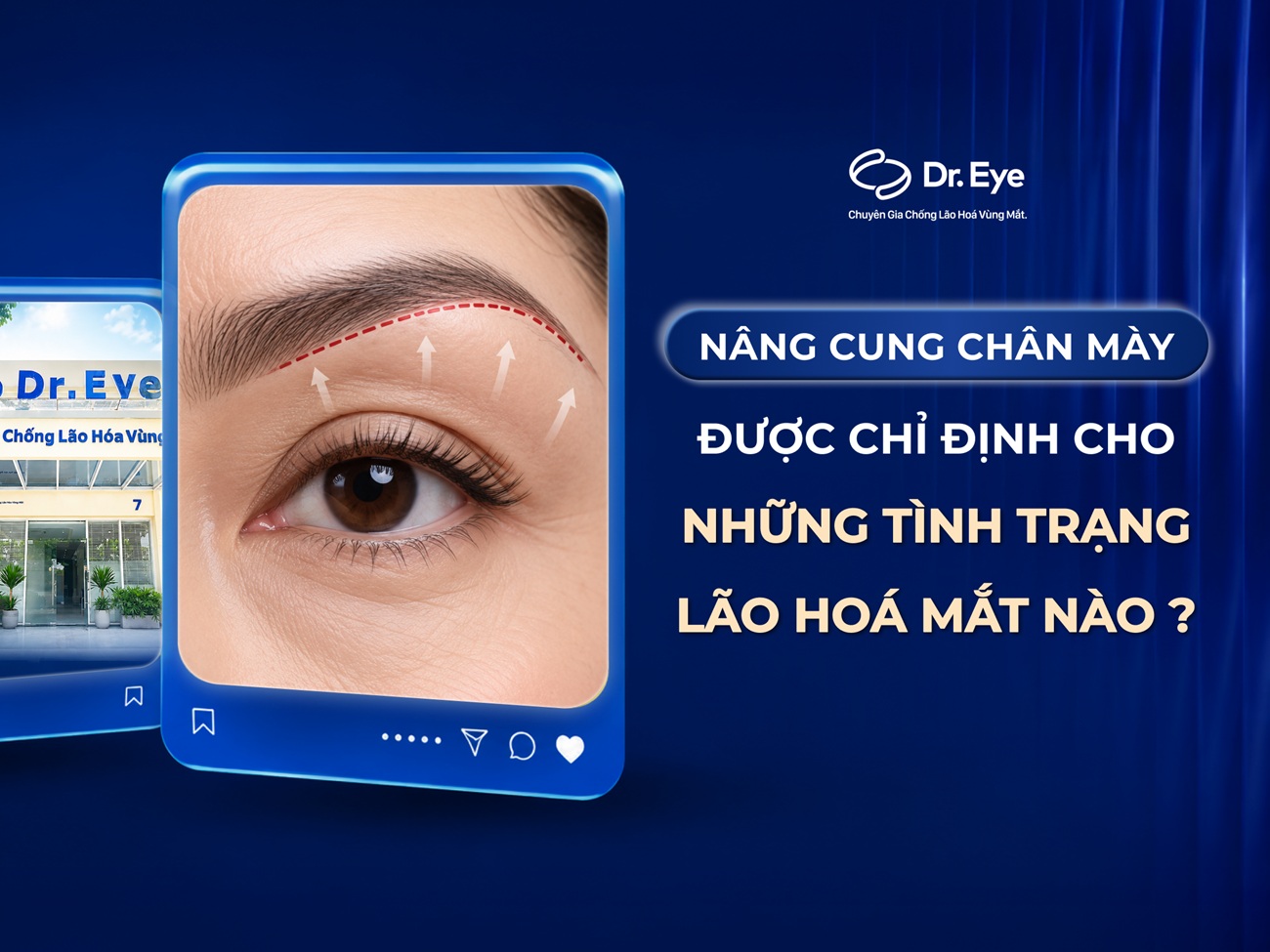
What conditions are brow lifts indicated for?

Consulting doctor:
Over 10 years of experience in oculoplastic and facial plastic surgery.
See more information about the doctorIn eye rejuvenation for middle-aged clients, it is important not only to address excess skin but also to accurately identify the underlying causes of heaviness in the upper eyelids. Sagging upper eyelids, low brow position, and ptosis due to the function of the eyelid elevator muscle are distinct conditions that may sometimes occur simultaneously. Therefore, the indication for a brow lift should be considered based on a comprehensive examination, aiming for a harmonious, natural result while preserving the function of the eyes.
Dr. Nguyen Thi Ly Na, Senior Specialist
What Eye Aging Conditions Are Indicated for a Brow Lift?
Brow lift is one of the eye rejuvenation solutions that many middle-aged women consider when they experience excess skin on the upper eyelids, drooping outer corners, sagging brows, or natural eyelid creases becoming obscured. However, not every case of heavy, lifeless eyes is suitable for this method.
At Dr. Eye, our specialized doctors conduct a thorough examination, assess the eyelid structure, brow position, and the causes of aging before recommending an intervention plan. Accurately determining the indications not only aims for effective rejuvenation but also helps preserve the natural contours and functions of the eyes.
So, what eye aging conditions are indicated for a brow lift? When should a brow lift be performed, and when is upper eyelid surgery or ptosis correction needed? Let’s explore these details with Dr. Eye in the article below.
1. What is a Brow Lift?
A brow lift is a group of cosmetic procedures performed to improve excess skin on the upper eyelids or adjust the position of sagging brows, depending on the cause of aging and the chosen technique.
For middle-aged women, the aging process can diminish skin elasticity, alter soft tissue structure, and reduce support in the brow area. These changes cause the upper eyelid skin to gradually sag, and the outer corners of the eyes tend to droop, making the gaze appear heavy and less vibrant.
At Dr. Eye, one of the methods consideredis brow lift for sagging brows, also known as Subbrow Blepharoplasty.
With this technique, the doctor creates an incision close to the lower edge of the brow, addresses the appropriate amount of excess skin, and may adjust or secure the soft tissue as needed. This method aims to improve the sagging skin covering the upper eyelid, particularly in the outer corner of the eye, while prioritizing the preservation of the original eyelid crease.
It is important to distinguish that the technique of removing excess skin from the lower brow does not mean lifting the entire brow higher. If the primary cause is that the brow is indeed sagging, the doctor will assess to choose a technique that can appropriately adjust the brow position.
 The loss and structural changes in the supporting tissue can cause the skin of the upper eyelid to become loose. The accumulation of excess skin forms folds, detracting from the natural neatness of the eyes.
As this condition progresses, clients may notice:
- Loose upper eyelid skin with multiple folds.
- Excess skin partially covering the natural eyelid crease.
- The visible distance between the eyebrow and the eyelid crease becoming narrower.
- A heavy, less vibrant appearance.
In cases where excess skin is concentrated in the appropriate area, particularly the outer part of the upper eyelid, the doctor may consider a subbrow lift to address the sagging skin.
By adjusting the amount of excess skin appropriately, the upper eyelid can appear more streamlined, allowing the eyelid crease to be more defined without necessarily needing to recreate a new crease.
However, if the excess skin is primarily concentrated at the eyelid crease or accompanied by structural abnormalities of the crease, upper eyelid surgery may be a more suitable option.
2.2. Droopy Outer Corners of the Eyes
Droopy outer corners of the eyes are a noticeable sign when the skin and soft tissue around the eyes lose their supportive capacity.
In many cases, excess skin is concentrated in the outer third of the upper eyelid, forming a fold that hangs down over the outer corner of the eye.
This condition can make the eyes appear droopy, reducing their brightness and leaving the face looking less lively.
During the examination, the doctor needs to determine whether the droopy appearance is due to excess upper eyelid skin, the position of the outer eyebrow, or a combination of both factors.
If the reasonThe primary concern arises from the excess skin in the outer upper eyelid area; a subbrow lift may help improve the condition of the excess skin in this location.
In cases where the tail of the brow is significantly drooping, the doctor may consider an appropriate lifting method to enhance the relationship between the brow and the eyelids.
The goal is not to lift the outer corners of the eyes as high as possible, but to improve the degree of sagging while maintaining balance and the natural appearance of the eyes.
2.3. Natural Eyelid Crease Hidden by Excess Skin
Many middle-aged women notice that their eyelid crease is becoming smaller and less defined, even though they previously had well-defined double eyelids.
The cause may not be a change in the eyelid crease itself, but rather the excess skin above gradually sagging down, covering the original eyelid crease line.
Common characteristics in this group of clients include:
- The natural eyelid crease remains visible when the excess skin is gently lifted during the examination.
- Both eyelids are relatively symmetrical.
- Excess skin is concentrated above the eyelid crease, especially at the tail.
- Clients wish to improve the eye area while retaining their existing eyelid crease.
This is one of the conditions where the doctor may consider a subbrow lift.
This technique allows for addressing the excess skin through an incision close to the lower brow edge, thereby helping to reveal the original eyelid crease more clearly in suitable cases.
For middle-aged clients, preserving natural contours is an important factor in the eye rejuvenation plan.
However, if the eyelid crease has many foldsIf the eyelids are uneven, disproportionate, or require structural restoration, the doctor may recommend upper eyelid surgery or a combination of other methods.
2.4. Sagging Brows Due to Aging
The brow plays an important role in the balance of the eye area and the upper third of the face.
As the supporting structure changes with age, the position of the brow may lower, especially at the tail. This condition is known as brow ptosis.
Possible signs include:
- The tail of the brow is lower than the appropriate position for the facial structure.
- The skin under the brow is sagging onto the upper eyelid.
- The distance between the brow and the eye appears to be narrowing.
- The upper eyelid area becomes heavy due to sagging soft tissue.
If the brow is truly sagging, simply removing excess skin may not fully address the underlying cause.
The doctor needs to assess the position of the head, body, and tail of the brow when the forehead muscles are relaxed, while also considering the degree of sagging and symmetry between both sides.
Based on the examination results, a brow lifting method may be considered to achieve harmony between the brow, eyelid crease, and overall facial appearance.
2.5. Asymmetry Between the Brows
In addition to excess and sagging skin, some middle-aged clients may experience asymmetry between the brows.
This may manifest as one brow tail being lower, differing amounts of excess skin on both sides, or uneven levels of sagging in the upper eyelid area.
This asymmetry may relate to anatomical structure and the activity of muscle groups.the forehead area or changes due to aging.
For cases of asymmetry related to brow position, the doctor may consider an appropriate lifting technique.
However, not every case of uneven brows requires surgery. Assessing the cause and the potential for improvement is essential before deciding on intervention.
The treatment goal is to improve symmetry within the limits of anatomical feasibility, rather than attempting to create two identical sides.
2.6. Excess Skin on the Upper Eyelid Combined with Sagging Brow
In middle-aged women, signs of aging around the eyes often do not appear in isolation.
A client may simultaneously experience excess skin on the upper eyelid, low-hanging brow tails, obscured eyelid creases, and sagging soft tissue around the outer eyes.
When multiple issues arise at once, addressing only the excess skin or solely adjusting the brow position may not fully meet rejuvenation goals.
In such cases, the doctor needs to conduct a comprehensive assessment and consider combining methods if indicated.
The choice of technique depends on the amount of excess skin, brow position, eyelid crease structure, eyelid muscle function, and the client’s health status.
At Dr. Eye, we prioritize intervention options that align with the causes of aging, aiming for natural results while minimizing unnecessary impacts.
3. Summary Table of Conditions to Consider for Brow Lifting
To help clients easily identify, Dr. Eye summarizes common conditions and guidanceProfessional assessment in the table below.
| Eye Area Condition | Common Symptoms | Considered Treatment Options |
|---|---|---|
| Excess Skin on Upper Eyelid | Loose skin, multiple folds, covering the eyelid crease | Subbrow lift or upper eyelid surgery depending on the location of excess skin |
| Droopy Outer Corners of Eyes | Skin around the outer eyes sagging, heavy appearance | Addressing excess skin under the brow or adjusting the brow if sagging is significant |
| Hidden Eyelid Crease | Original eyelid crease still suitable but covered by excess skin | Consider a subbrow lift to preserve the eyelid crease |
| Low Brow Position | Brow tail lowered, skin and soft tissue pooling on the upper eyelid | Evaluate techniques to elevate and adjust brow position |
| Asymmetrical Brow Position | Asymmetry in brow position or amount of excess skin | Assess the cause and potential for appropriate adjustment |
| Excess Skin Combined with Low Brow | Upper eyelid sagging, low brow, heavy outer corners of eyes | Consider combining techniques as indicated |
Note: The table above is for reference only. Determining the appropriate method should be based on a direct examination by a specialized doctor.
Unsure which category your condition falls into?
Please leave your phone number in the consultation form below. The Dr. Eye team will contact you to schedule an appointment for a specialized doctor to assess the structure of your eye area and advise on a treatment plan.Okay.
4. Cases Where a Brow Lift Should Not Be Performed
Although a brow lift is a method considered for many cases of aging around the eyes, not every instance of heavy eyelids or small-looking eyes has the same cause.
In particular, the doctor needs to clearly distinguish between three conditions: excess skin on the upper eyelid, low-hanging brows, and true ptosis.
4.1. Ptosis Due to Reduced or Abnormal Function of the Eyelid Lifting Muscle
Ptosis is a condition where the upper eyelid droops abnormally, which may cover part of the pupil and affect the openness of the eye.
Unlike excess skin on the upper eyelid, true ptosis may relate to the function of the eyelid lifting muscle or the structures controlling eyelid elevation.
If the primary cause lies with the eyelid lifting muscle, simply removing excess skin or lifting the brow will not substitute for specialized ptosis treatment.
The doctor needs to assess the position of the eyelid margin, the openness of the eye, and the activity of the eyelid lifting muscle to determine the treatment direction.
4.2. Hidden Eyelid, Multiple Creases, or Uneven Creases
For clients with a hidden eyelid, multiple secondary creases, or those wanting to create a more defined eyelid crease, upper eyelid surgery may be considered instead of just performing a brow lift.
Upper eyelid surgery allows the doctor to directly intervene in the crease area, address excess skin, and excess fat when indicated, and shape the eyelid crease appropriately.
If the client has both excess skin and low-hanging brows, the doctor…The doctor may consider combining techniques.
4.3. Cases Requiring Further Eye Health Evaluation
Clients with significant dry eye, difficulty fully closing their eyes, a history of eyelid surgery, thyroid conditions affecting the eyes, or uncontrolled health issues should undergo thorough examination.
Some cases may require delaying intervention, treating related conditions, or choosing alternative options.
Therefore, obtaining a health history and assessing eye function is a crucial step before performing any eye rejuvenation procedures.
5. How Do Brow Lifts, Upper Eyelid Surgery, and Ptosis Treatment Differ?
These three methods all relate to the upper eyelid but have different treatment goals and areas of impact.
| Criteria | Brow Lift | Upper Eyelid Surgery | Ptosis Treatment |
|---|---|---|---|
| Main Goal | Improve excess skin or sagging brows depending on the technique | Address excess tissue, reshape or adjust the eyelid crease | Improve the position of the eyelid margin and eyelid lifting function |
| Suitable Conditions | Excess skin on the outer upper eyelid, low brow, drooping outer corners of the eyes | Excess skin, excess fat, hidden eyelid crease, uneven eyelid crease | Ptosis due to abnormal eyelid lifting function |
| Area of Impact | Area of the brow or beneath the brow | Directly on the upper eyelid area | Structures related to eyelid lifting function |
| Natural Eyelid Crease | May be preserved if the structure is suitable | Can createnew or adjusted | Depending on the technique and accompanying conditions |
| Combination potential | Upper eyelid surgery or ptosis correction may be combined if necessary | Brow lift may be combined | Excess skin treatment may be combined as indicated |
An important distinction is that a brow lift is not a substitute for upper eyelid surgery or ptosis correction in all cases.
If the original eyelid crease remains harmonious but is covered by excess skin, a subbrow lift may be a worthwhile option to consider.
Conversely, if clients need to reshape the eyelid crease, upper eyelid surgery may better meet their goals. In cases where the eyelid margin is lowered due to the levator muscle, an appropriate ptosis correction method needs to be evaluated.
This is also why a thorough examination prior to the procedure plays a crucial role in selecting an eye rejuvenation plan.
6. Why do middle-aged women need a thorough evaluation before a brow lift?
In middle age, changes in the eye area are not only reflected on the skin surface but also involve soft tissue structures, brow position, and the activity of the levator muscle.
A heavy-looking eye can arise from various causes.
For example, two clients may both exhibit drooping outer corners of the eyes, but the first primarily has excess skin in the upper eyelid area, while the second has a low brow tail.
Although the external appearance may be relatively similar, the intervention approach may differ.
If solely relying on images or subjective feelings to assessChoosing a method, the real causes may not have been fully assessed.
At Dr. Eye, the examination process focuses on the following aspects:
- Assessment of excess upper eyelid skin: Determine the amount of sagging skin and its primary concentration.
- Examination of brow position: Evaluate the degree of sagging and symmetry between both sides.
- Assessment of eyelid crease structure: Determine the ability to preserve or the need to adjust the eyelid crease.
- Check the function of the eyelid elevator muscle: Differentiate between true ptosis and apparent ptosis due to excess skin.
- Evaluate health and treatment history: Consider factors affecting the suitability and safety of the procedure.
Based on the collected information, the doctor will advise on the appropriate plan for each client, while discussing the benefits, limitations of improvement, and potential risks involved.
7. What are the advantages of brow lift at Dr. Eye?
Dr. Eye is a specialized clinic focused on eye-area rejuvenation, concentrating on solutions to improve excess upper eyelid skin, sagging brows, under-eye bags, tear troughs, and related structural issues in the eye area.
For the brow lift service, we emphasize the following factors:
7.1. Specialist doctors conduct the examination
Each client is assessed for the structure of the eye area and signs of aging before selecting a method. The consultation process focuses on accurately identifying the cause rather than applying a one-size-fits-all technique.Agreement.
7.2. Prioritize Preserving Natural Features
In cases where the original eyelid crease is balanced, the doctor may consider elevating the lower brow to improve excess skin without necessarily reshaping the eyelid crease.
The goal is to help the eye area appear neat and vibrant while still harmonizing with the client’s features and age.
7.3. Focus on Aesthetic Stitching Techniques
The stitching technique is chosen based on the method and structure of the eye area, aiming to minimize aesthetic marks. However, the degree of healing and the potential for scar formation also depend on individual factors, post-operative care, and many other elements.
7.4. Dedicated Operating Room
Dr. Eye organizes minor surgeries in a model of one room, one bed, one client, emphasizing sterile control procedures, privacy, and focus during the process.
7.5. Post-Operative Monitoring and Care
After the procedure, clients are guided on how to clean the treated area, use prescribed medications, and monitor their recovery process. Follow-up appointments are scheduled based on the actual condition as advised by the doctor.
Register for a Consultation at Dr. Eye
Clients experiencing excess skin on the upper eyelids, drooping outer corners, or increasingly indistinct eyelid creases can leave their phone number for assistance in scheduling a consultation.
Hotline: 0899 099 799
8. What Risks Should Be Considered with Brow Lifts?
Brow lifting is a procedure that involves intervention in the eye area tissue, and therefore, certain risks still exist.
Potential issues may include swelling, bruising,bleeding, infection, scarring, asymmetry, changes in sensation in the treated area, or aesthetic results that do not meet expectations.
In some cases, individuals may experience difficulty closing their eyes or issues related to the surface of the eyeball, especially if there are pre-existing risk factors.
To minimize risks, the doctor needs to thoroughly assess the amount of skin to be treated, eyelid function, health status, and the client’s history of interventions.
After the procedure, if there is unusual increased pain, vision loss, significant bleeding, or concerning symptoms, clients should contact their doctor immediately for timely evaluation.
9. Frequently Asked Questions About Brow Lift Indications
9.1. At what age should one consider a brow lift?
There is no fixed age that applies to everyone. The indication for a brow lift depends on the condition of excess skin, brow position, health, and the desire to improve the eye area.
Middle-aged women often consider this method when they notice sagging upper eyelids, drooping outer corners of the eyes, or obscured eyelid creases.
9.2. Should someone with ptosis consider a brow lift?
If the eyes show signs of ptosis due to excess skin or low brow position, the doctor may consider a brow lift depending on the cause.
However, in cases of true ptosis due to functional abnormalities of the eyelid muscles, a specialized ptosis treatment should be evaluated. A brow lift alone does not replace the treatment of this underlying cause.
9.3. Does a brow lift change the natural eyelid crease?
A brow liftThe lower eyelid can help reveal the natural eyelid crease more clearly when the excess skin covering it is addressed.
However, the degree of change depends on the structure of the eye area, the technique used, and the amount of skin adjusted. The doctor needs to assess before consulting on the possibility of preserving the eyelid crease.
9.4. Should the droopy outer corner of the eye have a brow lift or upper eyelid surgery?
If the primary cause is excess skin in the outer upper eyelid or a low-hanging brow, the doctor may consider an appropriate brow lift method.
If the condition is accompanied by an unclear eyelid crease, the excess skin needs to be addressed directly through the eyelid crease or excess fat, and upper eyelid surgery may be prioritized.
9.5. Is it necessary to combine a brow lift with upper eyelid surgery?
Not every case requires the combination of both methods.
Combination is only considered when clients have multiple issues to address simultaneously, such as excess skin in the brow area combined with abnormalities in the eyelid crease or excess tissue at the upper eyelid.
9.6. Does a brow lift leave scars?
Any technique that involves making an incision on the skin has the potential to leave scars.
With the lower brow lift technique, the incision is typically placed close to the lower edge of the brow to help minimize the aesthetic visibility of the scar when healing progresses well.
The degree of scarring also depends on individual characteristics, technique, recovery process, and adherence to post-operative care instructions.
9.7. How can I know if I am suitable for a brow lift?
The best way is to have a direct examination by the doctor to assess the amount of excess skin, brow position, natural eyelid crease, and function.eyelid lifting.
Clients can send images of the eye area for preliminary consultation and to schedule an appointment at Dr. Eye. However, images do not replace a clinical examination.
10. Register for a brow lift consultation with specialist Dr. Eye
Excess skin on the upper eyelid, drooping outer corners of the eyes, and low-hanging brows are signs that can significantly affect the brightness of one’s gaze. However, each condition has different causes and intervention approaches.
A brow lift may be a suitable option when appropriately indicated, but it is not a universal solution for all signs of aging around the eyes.
At Dr. Eye, we emphasize in-depth examinations, honest consultations, and personalized rejuvenation plans, helping clients understand their conditions before deciding to proceed.
If you are experiencing sagging upper eyelids, drooping outer corners, hidden eyelid creases, or are unsure whether to opt for a brow lift or upper eyelid surgery, please register for a consultation for assistance.
LEAVE YOUR PHONE NUMBER TO RECEIVE CONSULTATION ON EYE REJUVENATION OPTIONS
The Dr. Eye team will contact you to assist in scheduling an appointment, allowing the specialist to directly assess your condition and recommend appropriate methods.
DR. EYE | SPECIALIZED CENTER FOR EYE AREA REJUVENATION
Hotline: 0899 099 799
Website: https://dreye.vn/
Introduction Dr. Eye
Understanding the desire to preserve the youthful beauty of the eyes for middle-aged women, Dr. Eye offers modern solutions to address all aging issues around the eyes such as sagging eyelids, eye bags, crow’s feet,…


Related articles





 BOOK AN APPOINTMENT


