


Distinguishing Between Brow Lift and Forehead Tightening | Dr. Eye

Consulting doctor:
Over 10 years of experience in oculoplastic and facial plastic surgery.
See more information about the doctor"In upper facial rejuvenation, the key is not how high the brow is lifted or how tight the forehead is pulled, but rather accurately identifying the structure that contributes to a heavy appearance. If the primary cause is excess skin beneath the brow, localized intervention may be appropriate. Conversely, when both the forehead and brow tissues are sagging, the doctor needs to assess a broader rejuvenation approach. Each indication should aim for harmony, preserving the function of the eye area while minimizing unnecessary interventions."
Dr. Nguyen Thi Ly Na, Senior Specialist
Distinguishing Between Brow Lift and Forehead Tightening in Upper Facial Rejuvenation
A brow lift and forehead tightening are both methods of upper facial rejuvenation that help improve signs of aging, making the gaze appear heavier and the face less vibrant. However, each method has different scopes of impact, intervention mechanisms, and indications.
While a localized brow lift focuses on improving excess skin around the brow or adjusting the position of sagging brows, forehead tightening has a broader scope, aiming to address the sagging of tissues in the forehead and brow area.
So when should you consider a brow lift? When is forehead tightening necessary? Is a brow lift alone sufficient to improve signs of aging in the upper face? Let’s explore these details with Dr. Eye to choose the solution that best fits your condition.
1. What is Upper Facial Aging?
In aesthetics, the face is typically divided into three tiers: the upper face, middle face, and lower face. The upper face primarily includes the forehead and brow area, closely linked to the structure of the upper eyelid.
Over time, the loss of skin elasticity, changes in soft tissue volume, and the underlying support system can cause the structures in this area to gradually change.
Common signs of upper facial aging include:
Loose skin in the forehead area, with horizontal wrinkles appearing.
The wrinkle between the brows becoming more pronounced.
Lowered brow position, particularlydistinct at the tail.
- The distance between the eyebrows and the eyes is narrowing.
- Excess skin on the upper eyelid is sagging, covering the eyelid crease.
- The outer corners of the eyes appear droopy, and the gaze lacks flexibility.
- The forehead muscles are frequently engaged to help lift the brow and expand the field of vision.
These signs may appear individually or simultaneously. However, not every case of excess skin on the upper eyelid is due to sagging of the brow or forehead area.
Accurately identifying the structure that is aging is essential for the doctor to choose the appropriate rejuvenation method, minimizing unnecessary interventions.
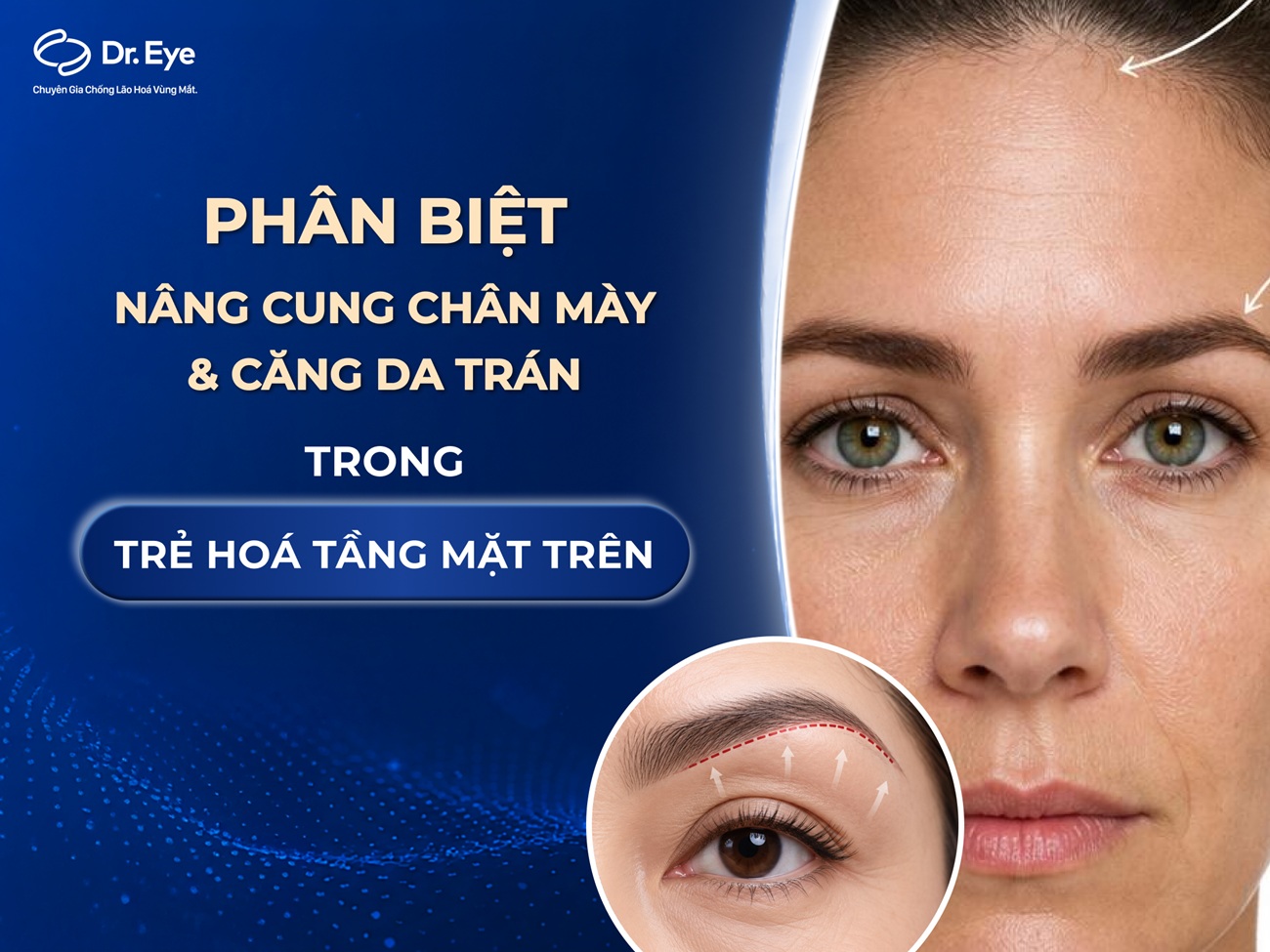
2. What is a Brow Lift?
A brow lift, also known as a brow suspension lift, is a group of aesthetic techniques that help improve issues related to the position of the eyebrows and the condition of sagging skin around the brow.
Depending on the anatomical characteristics and causes of aging, the doctor may choose to perform a brow lift using the upper approach, lower approach, or other suspension methods.
2.1. Lower Brow Lift
A lower brow lift, commonly referred to in medical literatureSubbrow Blepharoplasty or Infrabrow Excision is a technique that addresses excess skin located between the brow and the upper eyelid through an incision made close to the lower edge of the eyebrow.
This method is particularly suitable for cases where excess skin is concentrated in the area below the brow, especially on the outer side of the upper eyelid, while the position of the brow remains relatively appropriate for the overall facial structure.
Potential benefits include:
- Improving the condition of excess skin covering the upper eyelid.
- Reducing the feeling of heaviness around the eyes.
- Improving the condition of sagging skin at the outer corners of the eyes.
- Aiming to preserve the natural eyelid crease.
- Helping the eye area appear lighter and more refreshed.
The incision is placed close to the lower edge of the eyebrow, utilizing the natural boundary between the skin and the eyebrow to minimize the visibility of aesthetic traces after recovery.
It is important to note that a lower brow lift does not mean raising the entire brow higher. The primary goal of this technique is to address excess skin beneath the brow, thereby improving the appearance of the upper eyelid.
2.2. Upper Brow Lift
Unlike the lower technique, the upper brow lift involves an incision made close to the upper edge of the eyebrow.
This method allows the doctor to directly adjust the position of the brow, making it suitable for consideration when the brow is truly lowered or there is asymmetry between the two.The choice between the upper or lower approach should be based on the position of the brow when the forehead muscles are relaxed, the amount of excess skin on the upper eyelid, the characteristics of the eyebrows, and the individual rejuvenation goals of each client.droop, while also adjusting the position of the brow according to facial features.
Depending on the technique, the doctor may access through the hairline, inside the scalp, or other suitable locations.
This method is not simply about tightening the skin surface but may involve releasing, adjusting, and securing the underlying tissue structures to improve the droop of the upper facial layer.
3.1. Common Forehead Lifting Techniques
Endoscopic Forehead Lift
The doctor uses an endoscope to observe the underlying structures through small incisions in the scalp area. This method aims to adjust the tissue in the forehead and brow with smaller incisions compared to some open forehead lifting techniques.
Pretrichial Forehead Lift
The incision is placed at the junction between the forehead and hairline. This technique may be considered depending on the height of the forehead, the position of the hairline, and the degree of sagging skin.
Coronal Forehead Lift
This technique approaches through a longer incision located in the scalp area, allowing for broader tissue adjustment. However, this method also has its own limitations related to scar placement, scalp sensation, and hairline position.
Each technique has its own advantages, limitations, and indications; there is no one-size-fits-all method for all clients.
3.2. What Issues Can Forehead Lifting Improve?
The sagging of soft tissue in the forehead and brow area.
A widely lowered brow position.
Some horizontal forehead wrinkles and wrinkles between the eyebrows.
The heaviness of the upper eyelid area related to brow sagging.
The imbalance between the forehead, brow, and eyes.
However, forehead tightening is not a specialized method for addressing all conditions of excess upper eyelid skin, upper eyelid fat bags, or true ptosis due to weakened eyelid muscles.
4. Comparison Table of Brow Lift and Forehead Lift
The key difference between a direct brow lift and a forehead lift lies in the scope of intervention, the structures to be adjusted, and the rejuvenation goals.
| Criteria | Direct Brow Lift | Forehead Lift |
|---|---|---|
| English Name | Direct Brow Lift or Subbrow Blepharoplasty, depending on the technique | Forehead Lift |
| Scope of Impact | The area around the brow and the skin above the eyelids | The forehead and brow area over a wider range |
| Main Goal | Address excess skin under the brow or directly adjust the brow position | Adjust the tissue in the forehead area, lift the brow, and rejuvenate the upper face |
| Intervention Line Position | Along the upper or lower edge of the brow | Hairline, scalp, or other positions depending on the technique |
| Improve excess skin under the brow | This is the main goal of the lower technique | May improve indirectly if related to brow ptosis |
| Adjust brow position | Depends on the technique, the upper approach allows for direct lifting | Brow position can be adjusted through the forehead tissue system |
| Improve forehead wrinkles | Not the primary goal | Some wrinkles may improve depending on the cause and technique |
| Level of intervention | Usually more localized | Typically has a wider dissection range |
| Preserve natural eyelid crease | This is a goal of the lower technique | Does not directly recreate the eyelid crease |
| Anesthesia method | Usually can be performed under local anesthesia | General anesthesia or anesthesia options suitable for the technique |
| Recovery time | Depends on the level of intervention and individual factors | Depends on the technique, extent of intervention, and individual factors |
| Aesthetic traces | Scars are located near the brow | Scar location depends on the approach to the forehead or scalp |
| Suitable candidates | Clients with eyelid concerns focused around the brow and upper eyelid | Clients with sagging tissue in the forehead and brow needing broader adjustments |
Thus, forehead tightening does not automatically yield better results than brow lifting. Conversely, localized brow lifting does not eitherForehead lifting cannot replace brow lifting in every case.
The appropriate method is one that addresses the specific structures undergoing aging with the necessary scope of intervention.
Unsure which method is right for you?
Schedule a consultation with the specialized doctor Dr. Eye to assess the condition of your brow, excess skin on the upper eyelid, and the level of aging in the upper facial area.
Contact information will be used to assist with consultations and to arrange appointments.
5. Should you lift the brow or perform a forehead lift?
To determine whether to lift the brow or perform a forehead lift, the doctor will not only consider age or the number of wrinkles but will also conduct a comprehensive assessment of the anatomical features of the forehead, brow, and upper eyelid.
Case 1: Excess skin on the upper eyelid but the brow is still in the correct position
This condition can occur in middle-aged women when the skin around the upper and lower brow loses elasticity.
Although the eye area may appear heavy, with the eyelid crease being obscured, the primary cause may not be due to sagging in the forehead area.
If excess skin is concentrated below the brow and the natural eyelid crease remains appropriate, the doctor may consider a subbrow lift. If the excess skin is concentrated close to the eyelid crease, upper eyelid surgery may be a more suitable option.
A forehead lift in this case may not be a necessary intervention.
Case 2: Sagging browlow but the forehead has not aged much
In some clients, the lowering of the brow, especially at the tail, causes the eye area to lose its elegance.
When the sagging primarily focuses on the brow, the doctor may consider a direct lifting method or a suitable lifting technique without necessarily intervening in the entire forehead area.
Case 3: Forehead and brow both sagging
When the tissue structures of the forehead and brow change together, the signs of aging may manifest over a wider area.
In this case, localized brow lifting may not fully meet the rejuvenation goals. Forehead tightening or brow lifting through the forehead area are options that need to be evaluated by the doctor.
Case 4: Forehead with many wrinkles but brow not sagging
Forehead wrinkles are not always a sign that forehead tightening is needed.
If the wrinkles primarily form due to repetitive muscle activity or changes in skin quality, the doctor may consider less invasive treatment methods, depending on the case.
It is important to distinguish between wrinkles caused by muscle activity, static wrinkles, and actual sagging of soft tissue before choosing a method.
Case 5: True ptosis due to abnormal function of the eyelid elevator muscle
True ptosis is the condition where the upper eyelid is lowered due to abnormalities in the eyelid lifting system or other causes.
Clients with ptosis may frequently raise their eyebrows to compensate, causing the forehead to appearMany wrinkles and the eye area often appear tense.
If only excess skin is addressed or the brow is lifted without evaluating the function of the eyelid lifting muscles, the cause of ptosis may still persist.
Therefore, specialized ptosis treatment should be considered when the doctor identifies that the main issue lies within the eyelid lifting system.
6. Can a Brow Lift and Forehead Tightening Be Combined?
A brow lift and forehead tightening can be considered within the same upper facial rejuvenation plan if clients have multiple eyelid concerns simultaneously.
However, due to the overlapping impact of the two technique groups, the doctor needs to evaluate carefully to avoid redundant interventions or excessive tension in the eye and brow areas.
Additionally, depending on the actual condition, the doctor may consider other combination options such as:
| Aging Condition | Possible Consideration |
|---|---|
| Excess skin under the brow combined with excess skin near the eyelid crease | Brow lift combined with upper eyelid surgery |
| Excess skin in the upper eye area combined with under-eye bags | Brow lift combined with lower eyelid surgery |
| Drooping in the forehead, brow, and excess skin on the upper eyelid | Forehead tightening combined with upper eyelid surgery |
| Excess skin around the brow with true ptosis | Brow lift combined with ptosis correction when indicated |
| Excess skin under the brow, upper eyelid, and lower eyelid all aging | Combination of appropriate eye rejuvenation methods |
Combining multiple methodsThe law does not mean that the results will be better in every case. The goal of upper facial rejuvenation is to improve necessary signs of aging while maintaining the balance and harmony of the face.
7. Recovery Time After Brow Lift and Forehead Tightening
Recovery time is one of the factors that many middle-aged women consider when choosing a rejuvenation method, especially for clients with busy work schedules.
After Brow Lift
In the initial days, clients may experience swelling, bruising, mild tightness, or discomfort around the treatment area.
With the under-brow lift technique, the doctor will monitor the healing process, assess the stitches, and determine the appropriate time for suture removal, usually around 5 to 7 days if non-dissolvable sutures are used and recovery is progressing well.
The eye area will continue to reduce swelling, the stitches will gradually stabilize, and the soft tissue will need more time to recover naturally.
After Forehead Tightening
Due to the potentially wider treatment area, clients may experience swelling in the forehead, around the eyes, a feeling of tightness, or changes in sensation in the scalp area.
The time to return to daily activities depends on the technique used, the extent of the intervention, health status, and recovery progress.
Regardless of the chosen method, clients must follow care instructions, use medications as prescribed, and attend follow-up appointments as scheduled. The final aesthetic results should not be evaluated while the tissue is still in the healing phase.Recovery period.
8. Risks to Know Before Upper Facial Rejuvenation
Brow lifts and forehead tightening are both surgical procedures. In addition to the desired aesthetic results, clients need to be fully informed about potential risks.
| Brow Lift | Forehead Tightening |
|---|---|
| Noticeable scarring | Scarring in the treated area |
| Asymmetry of the brow | Asymmetry of the brow position |
| Hematoma or infection | Hematoma or infection |
| Altered sensation around the incision | Altered sensation in the forehead and scalp |
| Tightness or difficulty closing the eyes if the procedure is not appropriate | Risk of sensory or motor nerve damage |
| Results may not meet expectations | Changes in hairline or hair loss in the treated area |
To minimize risks, clients should undergo a thorough examination, disclose their medical history, medications being taken, previous cosmetic procedures, and any health issues related to the eye area.
After the procedure, if there is unusual increased pain, rapid swelling, prolonged bleeding, vision impairment, or significant difficulty closing the eyes, clients should contact their doctor immediately for timely evaluation.
9. Eye Rejuvenation at Dr. Eye: Addressing the Root Causes for a Natural Look
In middle age, beautiful eyes do not necessarily require a defined eyelid crease.Whether the brow is lifted high or not, youthfulness can come from adequately addressing signs of aging, helping to create a light and fresh look while maintaining individual beauty.
At Dr. Eye, with a specialized focus on eye-area rejuvenation for middle-aged women, we emphasize developing rejuvenation solutions based on the actual condition of each client.
One-on-One Consultation with a Specialist Doctor
Before making recommendations, the doctor evaluates the following factors:
The position of the head, body, and tail of the brow.
The degree and location of excess skin on the upper eyelid.
The distance between the brow and the eye.
The function of the eyelid-raising muscle and the activity of the forehead muscle.
The symmetry between both eyes.
The ability to close the eyes completely and the condition of the eyeball surface.
The aesthetic needs of each client.
The evaluation process helps distinguish cases suitable for brow lifting, upper eyelid surgery, or those that may require consideration of other intervention options.
Personalized Rejuvenation Plans
Instead of applying a one-size-fits-all approach, the doctors at Dr. Eye focus on identifying the causes of heaviness in the eye area, thereby advising on appropriate solutions.
For lower brow lifting, the goal is to address the necessary amount of excess skin, improving the condition.loose skin around the eyes and aims to preserve the natural eyelid crease.
Delicate Aesthetic Stitching Technique
The doctor emphasizes precision in every step, balancing the amount of skin to be treated and positioning the incision line close to the brow.
The multi-layer stitching technique combined with ultra-fine sutures aims to reduce tension on the skin surface, minimizing aesthetic traces after the healing process.
Dedicated Minor Surgery Room
Dr. Eye organizes the minor surgery room in a one room, one bed, one client model, focusing on sterile control, privacy, and experience throughout the procedure.
Close Post-Operative Care
Clients receive guidance on home care, monitoring recovery progress, and follow-up appointments as scheduled by the doctor.
We aim for a beauty journey with continuous support, from consultation, treatment, to post-operative care.
10. Answers to Frequently Asked Questions About Brow Lifts and Forehead Lifts
Are brow lifts and forehead lifts the same?
Not exactly the same. The two methods may both aim for rejuvenation of the upper face, but a localized brow lift focuses on the area around the brow, while a forehead lift typically affects the tissue of the forehead and brow over a wider area.
In international literature, the terms Brow Lift and Forehead Lift may overlap depending on the technique used.
Does a brow lift tighten the forehead skin?
A localized brow lift does not aim tois brow lifting. This method focuses on improving excess skin around the brow or adjusting the brow position depending on the technique, so it cannot replace brow lifting when intervention in the forehead area is indicated.
Does brow lifting improve excess skin on the upper eyelid?
Brow lifting may indirectly improve the heaviness of the upper eyelid if the cause is related to brow sagging. However, if excess skin is concentrated directly on the upper eyelid, clients may need an additional specialized treatment for excess skin.
Should women over 40 get a brow lift or brow lifting?
Age is not the only factor determining the method. The doctor needs to assess the brow position, the amount of excess skin on the upper eyelid, the degree of forehead sagging, and aesthetic desires before making a recommendation.
Does brow lifting eliminate the natural eyelid crease?
The underbrow lifting technique typically aims to preserve the existing eyelid crease. However, the appearance of the eyelid crease may change when the amount of covering skin is improved. Results depend on the structure of the eye area and the technique used.
Can brow lifting treat ptosis?
Brow lifting can improve the appearance of pseudo-ptosis related to brow sagging, but it does not replace the treatment for true ptosis due to functional abnormalities of the eyelid lifting system.
Do brow lifting and brow lifting leave scars?
Both methods can leave scars due to the intervention through the skin. The visibility of the scars depends on the location.Incision, suturing technique, healing tendency, and care process.
How Long Do the Results of a Brow Lift and Forehead Tightening Last?
Results can be long-lasting but do not prevent the natural aging process. The duration of results depends on the technique, tissue quality, age, individual characteristics, and lifestyle habits of each client.
What Is the Cost of a Brow Lift and Forehead Tightening?
The cost depends on the recommended technique, the extent of intervention, and whether other rejuvenation methods need to be combined. Clients should have an in-person consultation to receive specific advice on options and costs.
11. Register for a Consultation to Choose the Right Rejuvenation Solution
A brow lift or forehead tightening should not be chosen solely based on the visible sagging skin. It is important to accurately identify the causes of aging, the structures that need adjustment, and the appropriate extent of intervention.
If you are experiencing excess skin on the upper eyelids, sagging brows, droopy outer corners of the eyes, or an increasingly heavy appearance, let the specialized doctor at Dr. Eye assist you in finding the right improvement solution.
Register today for support:
Evaluate the signs of aging around the eyes.
Differentiate between excess skin on the upper eyelids, sagging brows, and ptosis.
Consult on personalized rejuvenation methods.
Answer questions about the process, recovery time, and costs.implementation fee.
RECLAIM YOUR YOUTHFUL GLOW WITH DR. EYE
Leave your phone number to receive consultation support and schedule an appointment with a specialized doctor.
Hotline: 0899 099 799
Website: dreye.vn
Medical References
American Society of Plastic Surgeons (ASPS). Brow Lift Risks and Safety.
American Society of Plastic Surgeons (ASPS). Brow Lift Recovery.
National Center for Biotechnology Information (NCBI). Direct Brow Lift, StatPearls.
National Center for Biotechnology Information (NCBI). Endoscopic Brow Lift, StatPearls.
Introduction Dr. Eye
Understanding the desire to preserve the youthful beauty of the eyes for middle-aged women, Dr. Eye offers modern solutions to address all aging issues around the eyes such as sagging eyelids, eye bags, crow’s feet,…


Related articles








 BOOK AN APPOINTMENT


